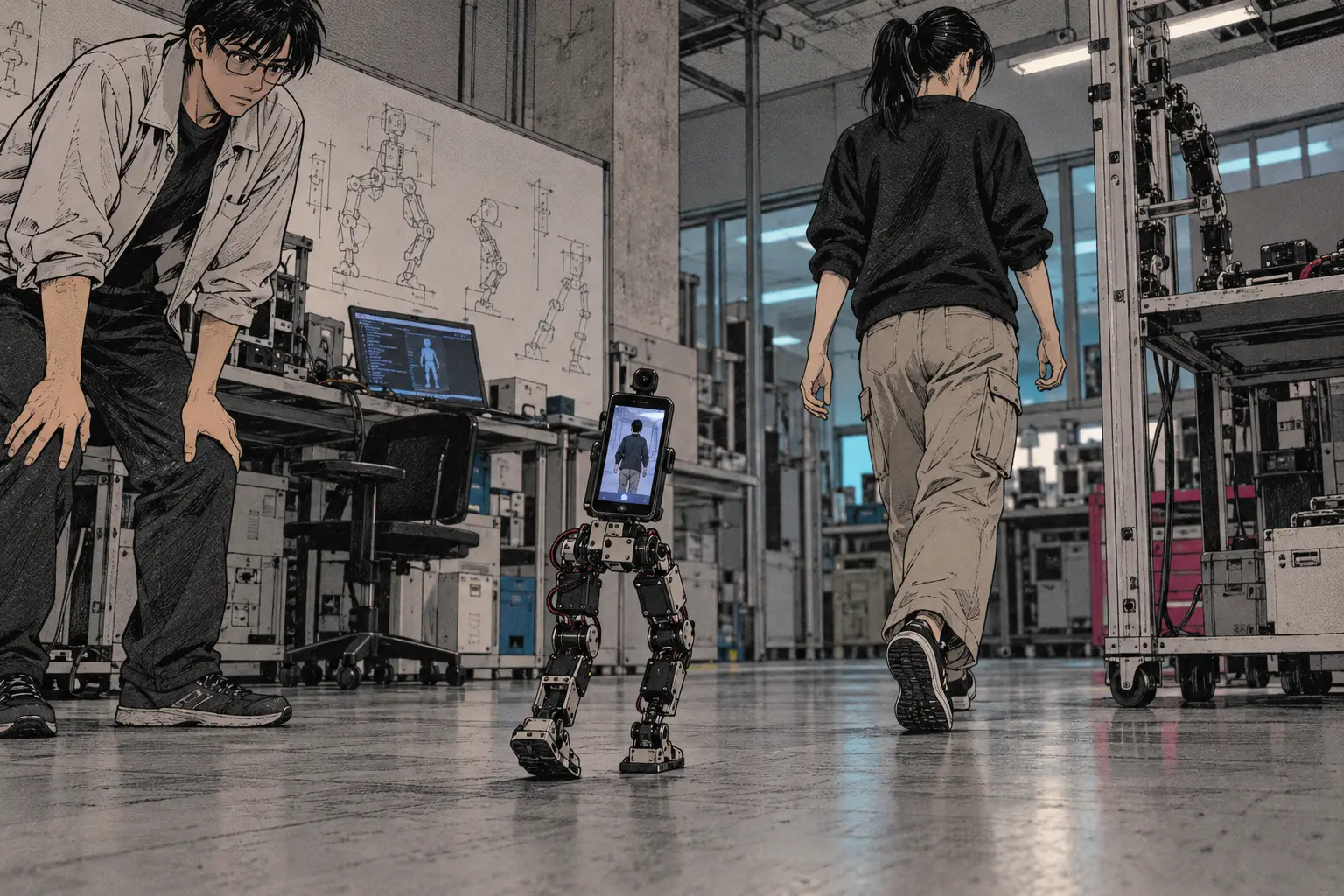
A 48.3-centimeter biped weighing 1.8 kilograms has walked under the control of a repurposed Android phone serving as its camera, motion sensor and primary computer. The UCLA machine, called PhoneBot, replaces much of the dedicated sensing and processing hardware found on research humanoids with components already packed into a consumer handset.
The open-source robot has 13 low-cost servo motors: six in each leg and one that swivels its phone-carrying torso. That extra joint can turn the camera to track a person without requiring the entire robot to pivot. According to New Atlas Robotics, researchers also demonstrated the robot following a person and standing up after being placed face down.
The phone’s camera provides vision, while its inertial measurement unit measures tilt and movement for balance. Its processor runs the neural network controlling the joints, and the touchscreen provides status information and controls. The handset is not physically wired into the motor system: it communicates over Wi-Fi with a small onboard computer that relays commands to the servos. The researchers say this arrangement makes it easier to exchange phones.
PhoneBot learned its gait through reinforcement learning in simulation before walking on the physical robot. The training rewarded it for staying upright, keeping pace and alternating its steps, while penalizing behavior such as dragging its feet. The simulation included limits on motor strength and speed as well as play in the servo gears, an attempt to prevent the learned controller from demanding movements the low-cost mechanism could not produce.
The researchers tested the system with four Android handsets: a 2017 Honor 9 and three prepaid phones costing about $50 to $80. All four handled motion sensing, walking control, on-device vision and interaction, according to New Atlas. Camera-based mapping and localization did not run on the Honor 9, however, which the researchers attributed to Google services being unavailable on that device in the United States. The tests do not establish compatibility with every Android device.
The phone does not yet make the robot fully self-contained. Speech recognition and the language model used for conversation run on a nearby laptop reached over Wi-Fi, while walking and vision run on the handset. The arXiv preprint also lists filming and mobile telepresence among the platform’s capabilities, but the supplied reports give no performance figures for those functions.
PhoneBot remains a small research platform rather than a finished household companion. It has no arms, its walking controller was trained only for flat ground, and its small servos restrict payload and available movements. Walking speed, battery runtime, duty cycle and payload capacity were not disclosed in the supplied reports. The team estimates the body costs about $400 without the smartphone, compared with roughly $3,500 to $13,800 for other small research humanoids cited in the paper, although those machines have different capabilities. The team plans to explore uneven terrain, lightweight arms and language-model-based planning, and has suggested running suitable language models directly on the phone.