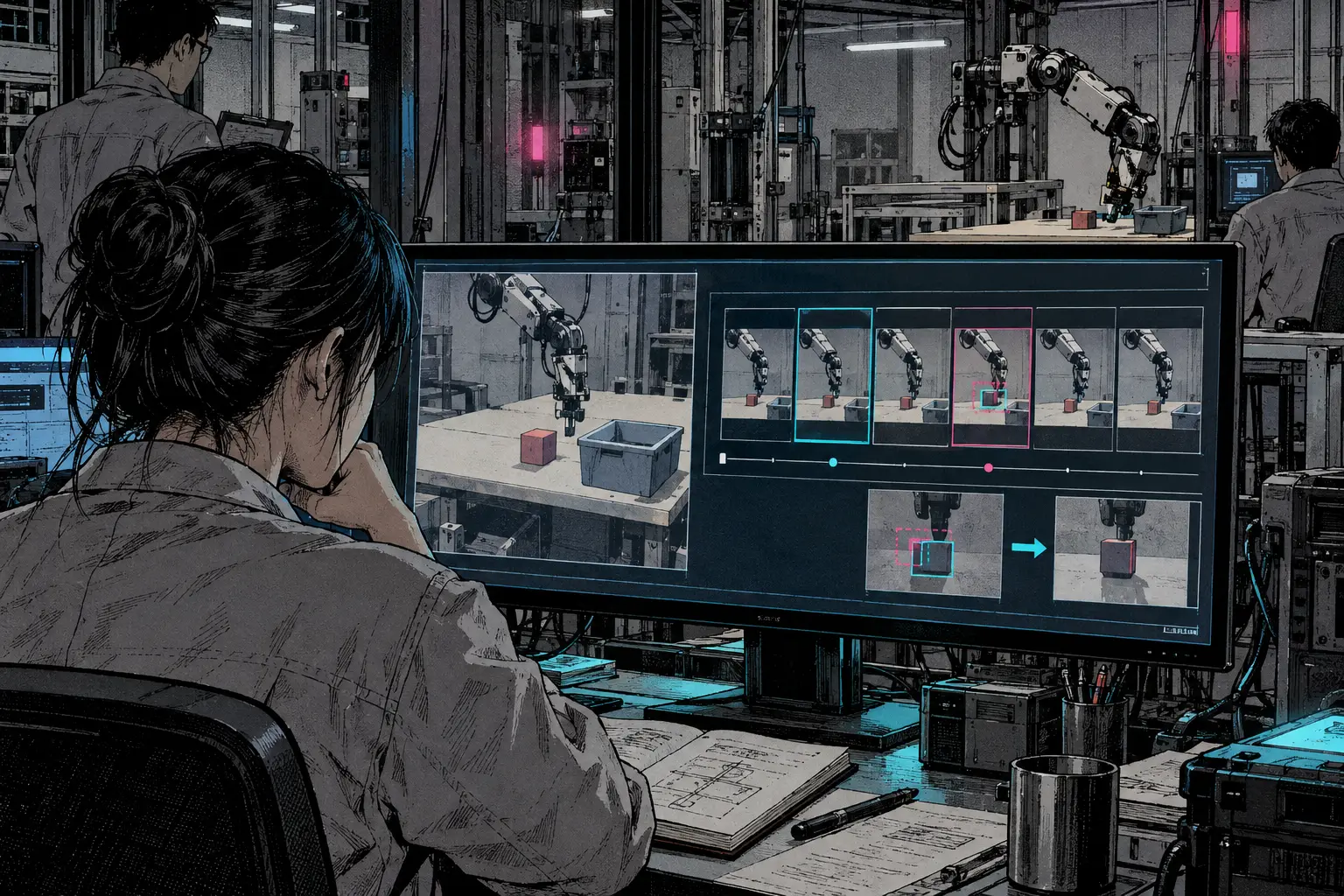
FAVOR is a framework designed to recover from execution drift by guiding a robot back toward states depicted in predictions made before it acted. It stores those predicted frames as anchors, compares them with the robot’s progress and generates a corrective instruction when execution deviates in a way that breaks the task, according to an arXiv preprint published Oct. 5, 2026.
The system is designed for world action models, or WAMs, which first predict how a manipulation task should unfold and then decode actions from that predicted future. If execution drifts from the prediction, the remaining actions may no longer be valid for the robot’s altered state.
Simply replanning from that state rarely restores what the task still requires, the preprint says. The state may also be outside the model’s training distribution, while existing execution monitors can determine when to stop but not what must be restored. FAVOR instead preserves the original prediction and treats its frames as anchors for subsequent execution.
Its Anchor Verifier compares each new observation with the corresponding anchor while also considering the actions already executed. It flags deviations that break the task. The supplied abstract does not disclose verification latency, computational load, sensor specifications or the magnitude of displacement from which the system can recover.
When the verifier flags a deviation, an Anchor-Guided Recovery component uses a vision-language model to turn the flagged anchor into a short corrective instruction. Under strengthened instruction guidance, the world action model executes that instruction to return to the intended future, then resumes the original task.
FAVOR produced small benchmark gains without modifying the underlying policy. Success on LIBERO rose from 97.85% to 98.10%, an increase of 0.25 percentage points. On LIBERO-Plus, success increased from 72.60% to 72.98%, or 0.38 percentage points.
The reported results show aggregate benchmark gains for FAVOR but do not establish broad physical reliability. The supplied abstract gives no robot hardware, task-by-task recovery rate, recovery time, force data or specified real-world contact-disturbance trials. The framework’s stated approach is to preserve predicted frames, use them to detect task-breaking deviations and guide online recovery; its performance under noisy sensing, collisions or unfamiliar objects is not disclosed.