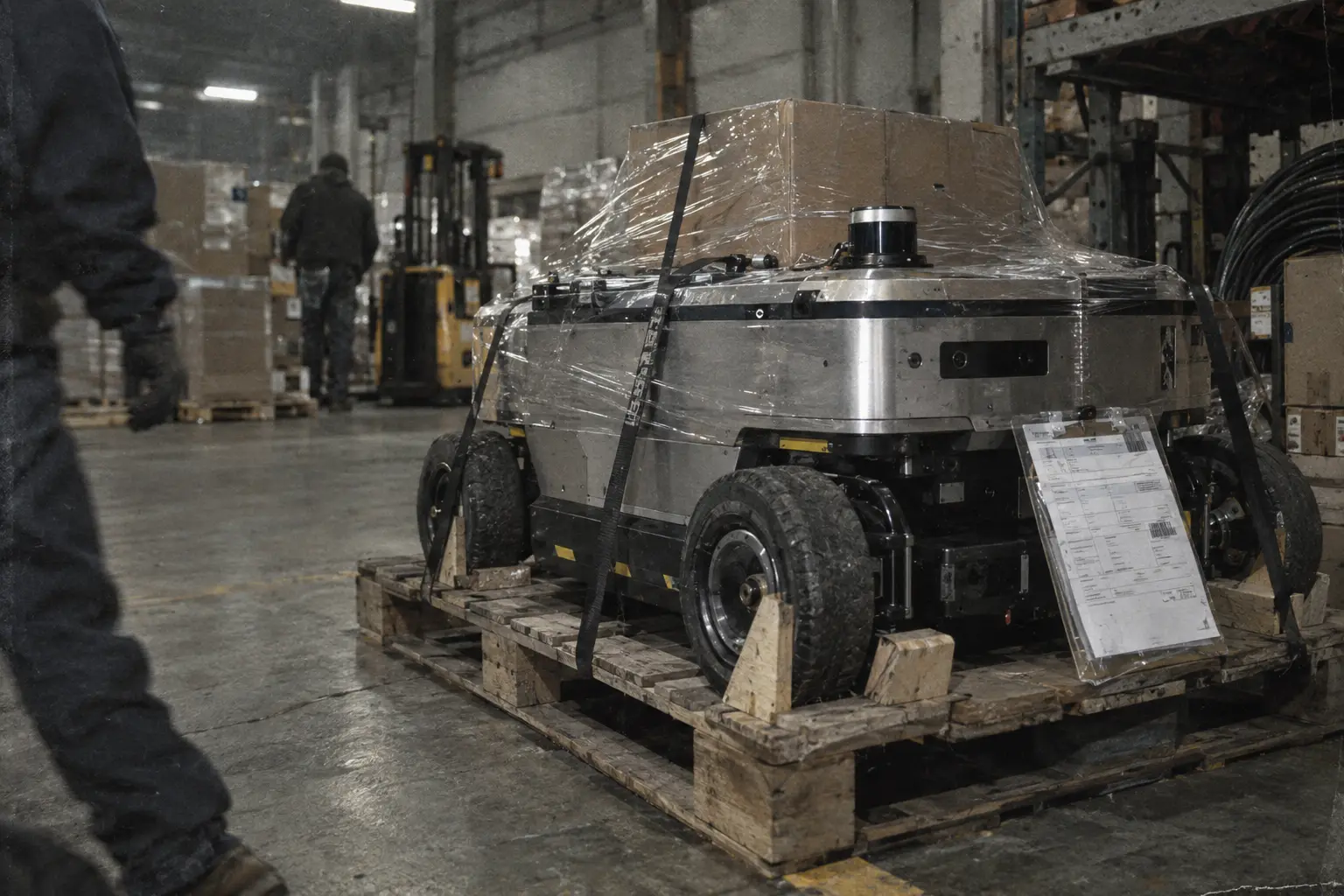
The U.S. Federal Communications Commission added foreign-produced mobile, communicating robots weighing more than 2 kilograms to its Covered List on 28 July, making new products in that category ineligible for import, according to IEEE Spectrum. The restrictions extend beyond China to manufacturers in allied countries, putting access to the U.S. robotics market—and decisions about where to build robots—under new pressure.
The distinction for buyers is that devices already certified remain unrestricted for sale or use. The FCC defines the affected “advanced robotic devices” as mobile systems with on-board sensing, communications and some autonomy. Drones, connected vehicles and medical devices are exempt from this particular restriction. Systems weighing under 2 kilograms and those communicating at less than 200 kilobits per second also fall outside its scope, Spectrum reports.
The Department of Defense–driven action rests on two arguments: that the United States needs its own robotics supply chain and industrial base, and that robots monitoring critical infrastructure in sensitive locations can present security risks. The FCC describes the measure as country neutral. However, U.S. national security sources told Spectrum that China was the perceived threat. The department’s supporting material includes Spectrum’s reporting on a critical vulnerability in robots made by China’s Unitree.
Foreign manufacturers seeking clearance face requirements that go well beyond a technical review. According to Spectrum, applicants must provide “a detailed, time-bound plan to establish or expand manufacturing in the United States for the advanced robotic device.” Applications must reach the Department of Defense and FCC by 1 January 2028. That deadline leaves a question over access for devices developed later, while the manufacturing requirement makes U.S. production plans part of the approval process.
Swiss quadruped maker ANYbotics plans to seek conditional approval for future products, its vice president of strategy, Philipp Frey, told Spectrum. That process will involve a national-security review, disclosure of beneficial ownership and supply-chain risks, and a plan for a significant U.S. manufacturing presence. Frey said American enterprise customers increasingly judge robots on reliability, cybersecurity, software, safety certification, serviceability and integration—not hardware price alone.
Some U.S. manufacturers welcomed the move. Boston Dynamics vice president of policy Brendan Schulman endorsed it on LinkedIn, writing: “I sense that this is just the first round in a series of policies that will define the success and growth of the industry for decades to come.” Persona CEO Nic Radford told Spectrum that American customers already wanted technology they could audit, rapid support and systems that did not depend on fragile overseas supply chains.
The sourcing challenge does not stop at the border. China produces a large fraction of robot components, including parts used in machines assembled in the United States, Spectrum reports. That dependence gives China leverage until American robotics companies diversify their supply chains. China’s Ministry of Commerce opposed the FCC measures, describing them as discriminatory despite their country-neutral presentation.
Brookings Institution sociologist Kyle Chan offered a warning against broad restrictions in a report cited by Spectrum. He advocated coordinated federal decisions and restrictions adjusted to defined risks, preserving partnerships with Chinese manufacturers in less sensitive supply-chain links. Without those partnerships, he argued, crude bans could hinder American startups and researchers and slow innovation across U.S. robotics.