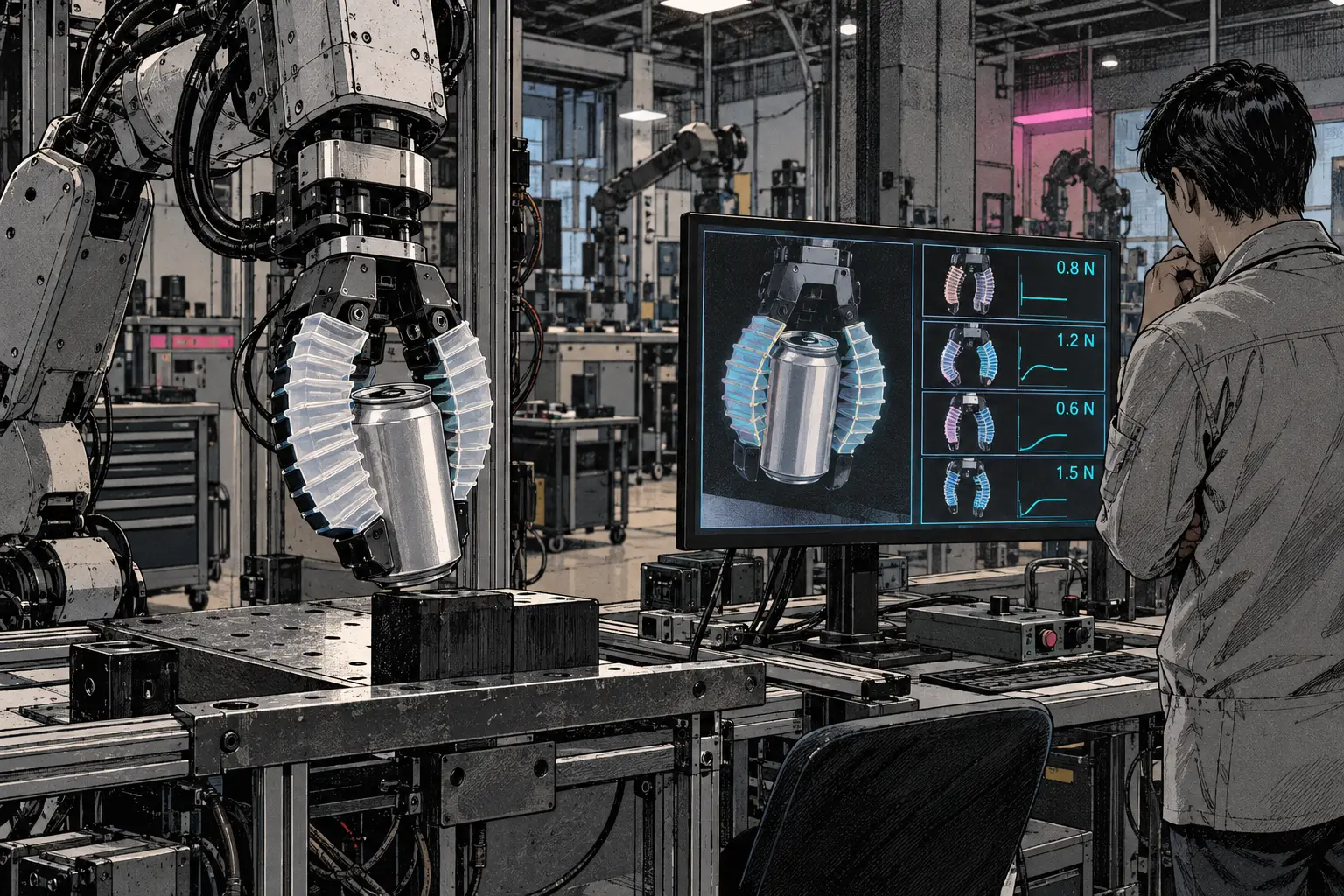
A compliant Fin Ray gripper estimated contact force from its visible deformation and used that estimate to select robot actions without force or tactile sensors at deployment, according to an arXiv preprint. The approach uses the gripper’s deformation as a force signal, but the supplied report gives no numerical measure of force-estimation accuracy or task success.
The system uses two learned models. First, a visual force estimator is trained on calibration data. That estimator then annotates task demonstrations with force estimates, producing demonstrations augmented with the forces associated with the actions.
A second model learns to propose robot actions and their expected forces. During a task, the system samples candidate actions, compares their predicted forces with a target from the demonstrations and executes the candidate whose predicted force is closest to that target. The method thus selects among proposed actions using predicted force.
The researchers evaluated the approach on berry picking, empty-can grasping, in-hand reorientation and plug insertion. The supplied excerpt does not give further details about the individual evaluations.
The report says visual force prediction guided action selection across those tasks, but it does not provide success rates, force errors, object-damage rates or comparisons with a physical force sensor. It also gives no force range, operating speed, image latency, trial count or description of the robot’s other hardware. Without those figures, the method’s performance and limitations cannot be assessed from the excerpt.
The deployment claim is narrower than a completely sensor-free training process. The force estimator was trained on calibration data, but the supplied material does not explain how reference forces for that calibration were obtained. It also does not say where the visual observations came from or report the effects of lighting, occlusion, object differences or contact geometry.
The stated approach uses a compliant gripper’s changing shape to estimate contact force, then uses that estimate to select actions without separate force or tactile sensors during deployment. The available excerpt does not establish the estimate’s numerical accuracy, speed or robustness, or its performance beyond the four listed manipulation tasks.