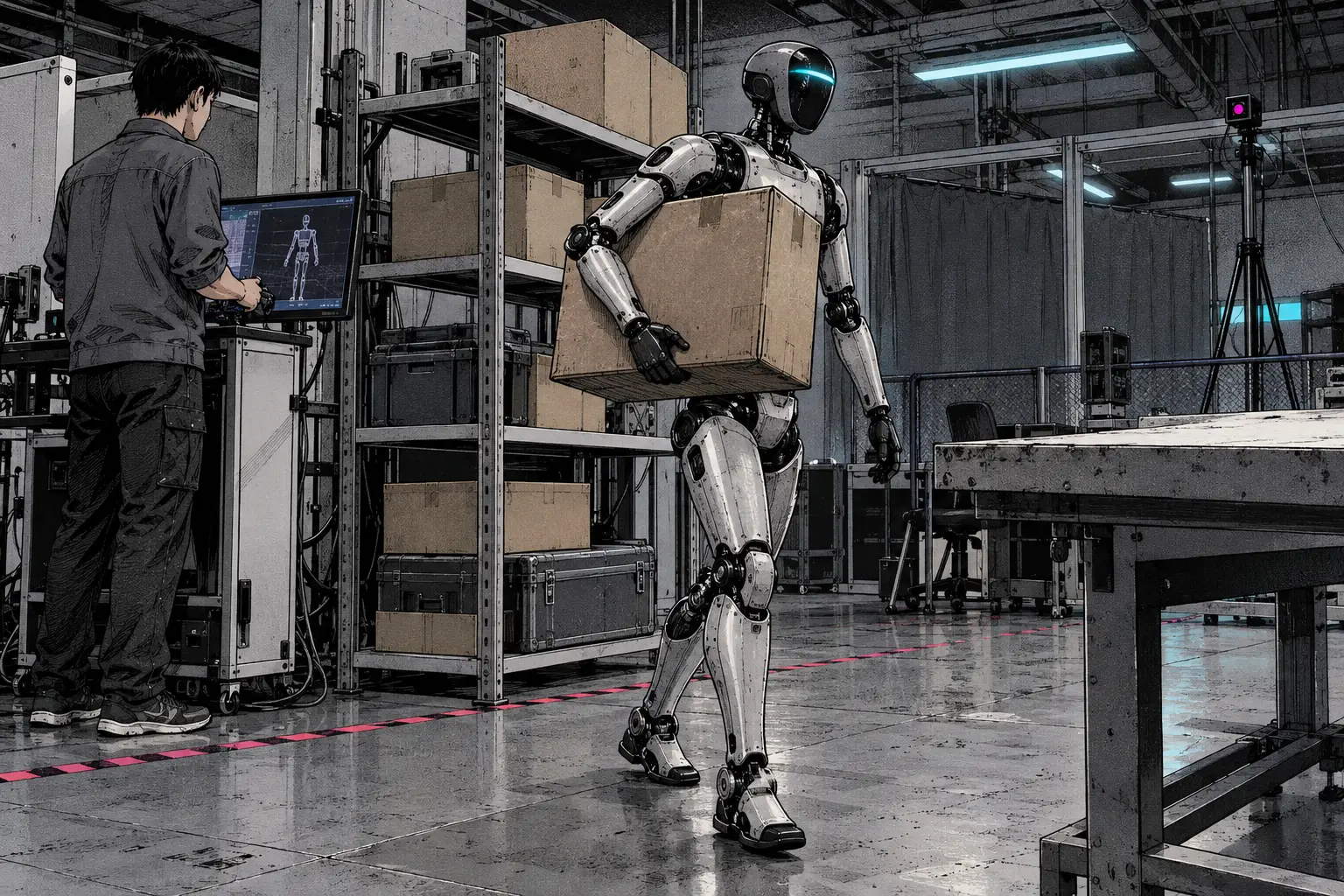
A Unitree G1 tucked a cardboard box under one arm, carried it from a shelf to a table and placed it using a controller trained to use the humanoid’s body as a contact surface. The same system repositioned both the box and a basketball around the robot’s torso, according to an arXiv preprint.
The work addresses a limitation in current humanoid manipulation: it remains largely confined to end-effectors and simple grasps. By contrast, humans can engage the entire body, including bracing and sliding bulky objects against the arms and torso.
The researchers call their framework Whole-Body Dexterity. It uses the robot’s body and appendages as contact surfaces for grasping and manipulating objects. In the reported demonstrations, the robot moved objects between different regions around its torso before carrying or placing them.
Training began in simulation with the generation of a dataset of feasible whole-body grasps. Reinforcement-learning experts were then trained on an “any-to-any” repositioning objective, sampling both initial and goal grasps from that dataset. Those specialized controllers were distilled into one policy that uses the robot’s proprioception and information about the object’s geometry.
The researchers report that the resulting policy transferred zero-shot to a real Unitree G1. In the longer sequence, the robot moved the box from a shelf, stowed it under one arm, carried it to a table and placed it. The preprint describes this sequence as a long-horizon task.
The robot received human direction. A teleoperator supplied coarse motion references while the controller operated interactively. The supplied report does not state the control latency or quantify the teleoperator’s input beyond describing those references as coarse.
Across the reported real-world whole-body manipulation tasks, the distilled controller completed 90% of trials. Direct retargeting completed 18%, while a generalist whole-body controller completed 4%, according to the preprint. The supplied report does not disclose the number of trials, object weights, movement speeds, sensing setup, battery impact or performance on other shapes and materials. Its real-world results are limited to the reported objects and tasks.