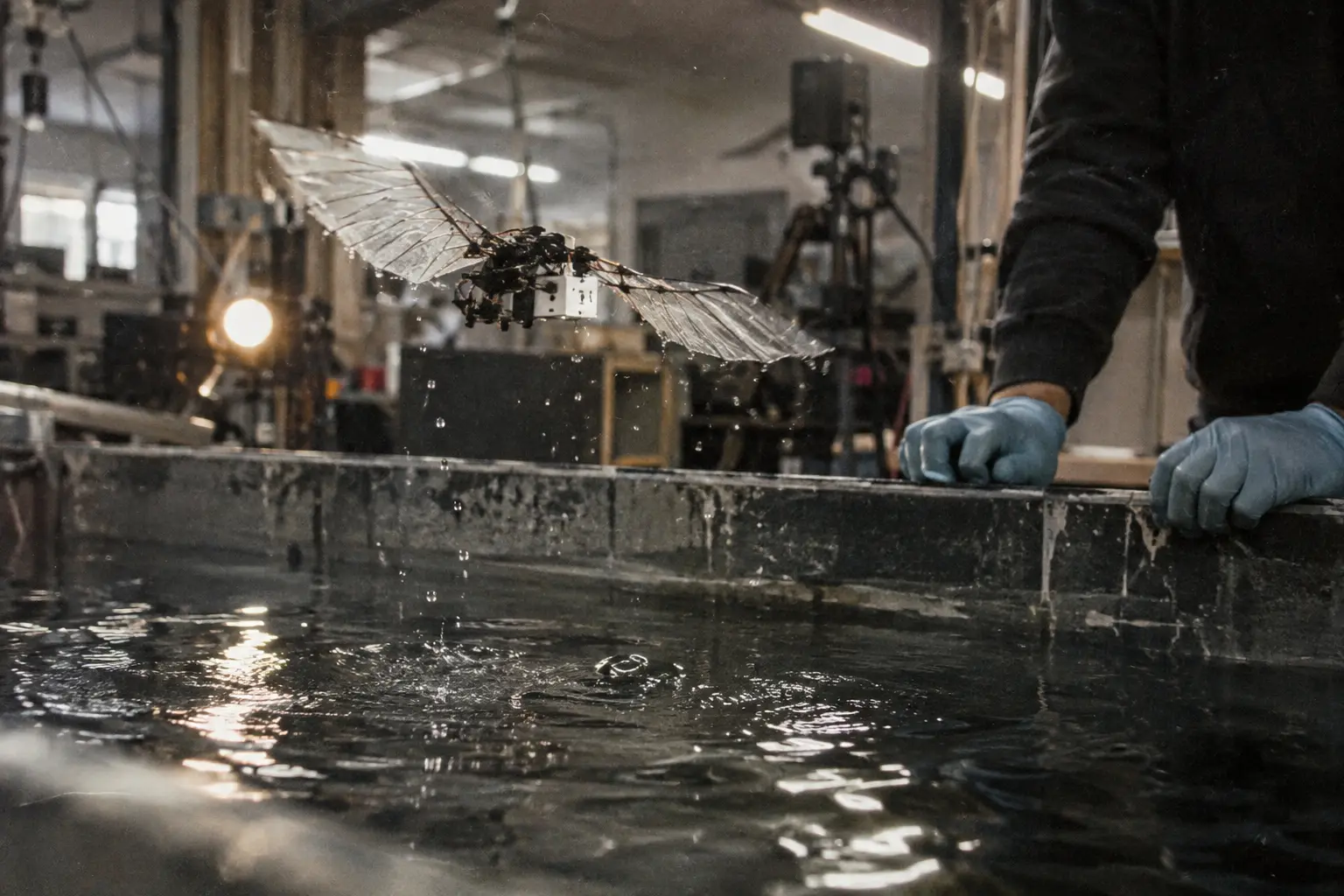
Engineers at MIT and EPFL have built a robot that swims underwater, then flaps out of the water and into flight, according to MIT News. Weighing less than 300 grams, the bird-inspired machine demonstrates a design that could eventually let researchers collect measurements in aquatic areas too dangerous for traditional ocean vessels to access and return the data by air.
The flapping-wing aerial-aquatic vehicle, or FAAV, was tested in a water tank and in Lake Geneva in Switzerland. The results appear in Science, MIT News reports. Led by MIT assistant professor of mechanical engineering Raphael Zufferey, the study includes researchers from EPFL and Northwest Indian College. Its immediate purpose is to investigate how diving birds move through air and water; ocean-monitoring missions remain a future ambition, not a demonstrated capability.
The engineering challenge is substantial: water is 1,000 times denser than air. The team examined published data on puffins, petrels, kingfishers and other diving birds to guide its design. The resulting robot has a central body containing a battery and waterproof electric motor, two flexible wings and a steerable tail. A crankshaft drives the wings up and down, while thin wing membranes coated with hydrophobic nanoparticles help shed water.
The researchers tested small, medium and large wings, starting the robot about half a meter below the surface and programming its flapping frequency and tail angle. According to MIT News, the medium-sized wings, measuring 80 centimeters wide, enabled reliable swimming, flying and transitions between the two. Flexibility proved crucial: the wings needed to bend enough to limit their flapping amplitude underwater while remaining firm enough to support flight in air.
In the tests, FAAV swam at almost 1 meter per second while flapping around five times per second. It flew at around 6 meters per second with a similar flapping frequency. To emerge successfully, the robot needed to pitch at 70 degrees, keeping its wingtips clear of the surface as it climbed into the air. A steeper angle caused it to tip back into the water, MIT News reports.
Unlike many diving birds, the robot did not need feet to paddle during takeoff. “If you look at birds, most birds need to paddle at the surface to take off. And the question was, do we need the same for robots? And it turns out we don’t,” Zufferey told MIT News. The finding shows that a robotic version need not reproduce every movement of its biological model.
The researchers envision future vehicles launching from shore or a boat, flying toward an iceberg, port facility or pod of whales, then diving to take measurements or samples. Returning by air could make repeated observations possible without relying on a vessel to reach each sampling location. Those proposed uses could address the difficulty of gathering ocean data frequently and across many locations.
The team is now improving the wings so they can turn as well as flap. It also intends to test performance in choppy water and wind before pursuing ocean-science deployments. Those planned tests would examine how the design handles turbulent conditions while swimming out of the water and flying through the air.