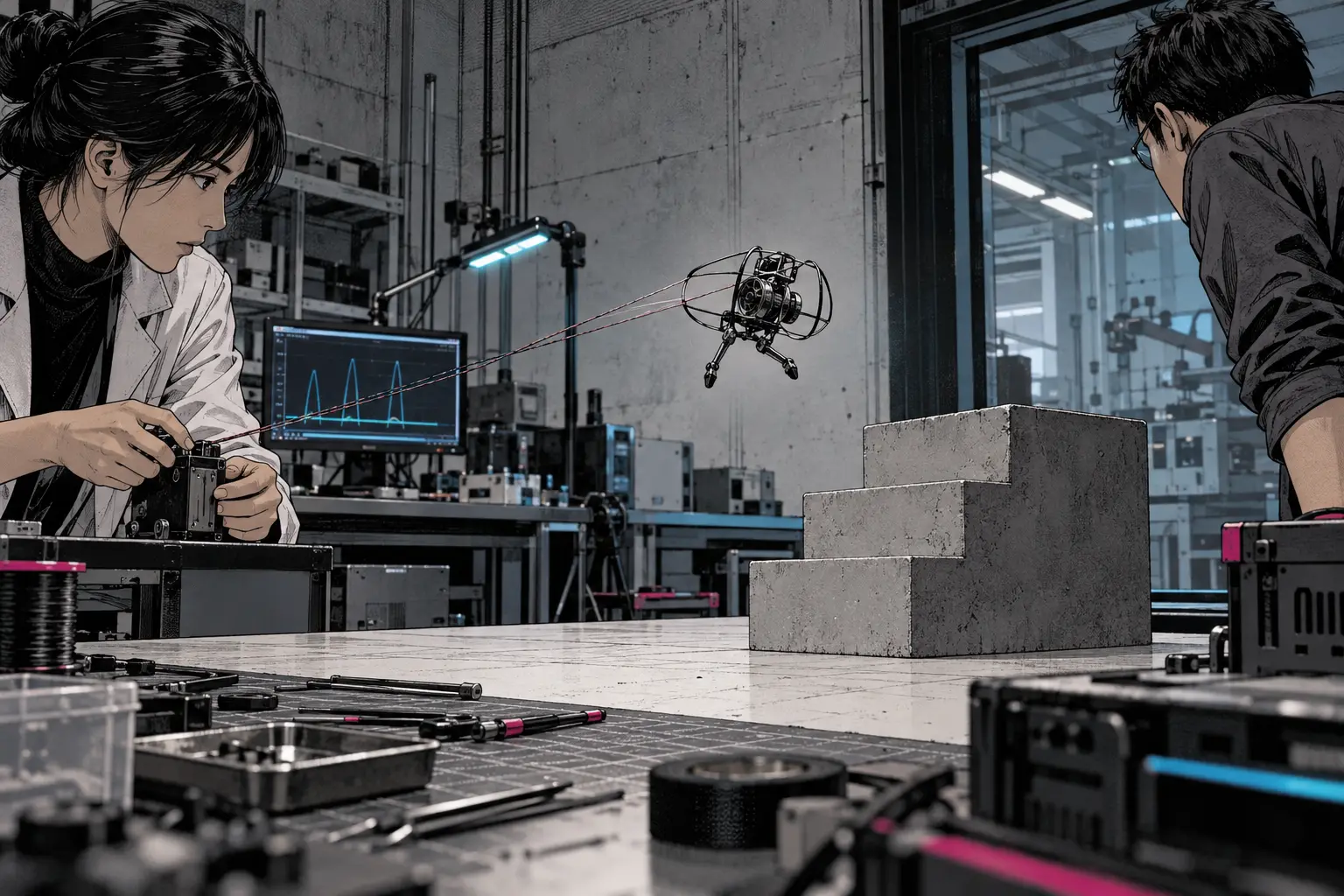
A 1-gram robot can jump higher than a standard stair by varying the electric current sent to its launch motor. The palm-sized DirectHop prototype uses that control to make both large leaps and small, controlled hops, according to New Atlas, rather than releasing the same fixed burst of energy every time.
University of Washington engineers built the three-legged machine around an unusual motor-driven launcher. Its legs do not propel it by pushing against the ground like those of a frog or insect. Instead, the motor pulls the robot upward, assisted by a pulley and two strings. Changing the motor current changes the energy delivered to the jump, giving operators control over its height and distance.
That approach addresses a limitation the researchers identify in spring-loaded hopping robots: a mechanism designed to release a fixed amount of stored energy can behave like an “all-or-nothing” launcher. The report says DirectHop’s mechanism can produce very small, controlled hops as well as higher jumps. It provides no measured maximum height, horizontal range, launch speed or landing accuracy; “higher than a standard stair” is the only scale given for its jump performance.
The robot also has to recover when those jumps end badly. A motor shifts its centre of gravity, making the body twitch and roll until its three folding legs return to the ground. Around the mechanism is a curved protective cage inspired by the shape of a box turtle. The cage uses flexible carbon-fibre rods just 0.25 mm in diameter, and DirectHop reportedly righted itself in about 90% of laboratory cases.
That result does not establish performance outside the laboratory. New Atlas gives no number of trials behind the 90% figure and no durability data for repeated impacts, rough ground, dust, water or collisions. The prototype carries no battery or sensors: power arrives through wires, and it relies on human operators because it cannot detect the required jump height or determine its orientation. The report provides no results from real-terrain testing.
The team is working on onboard solar cells, a battery, a camera and navigation electronics, along with retractable feet intended to adjust the jumping angle and reduce bad landings. Researchers ultimately envision swarms monitoring soil and water, inspecting oil refineries and exploring other difficult-to-reach locations, and estimate that a future robot could cost about US$10. For now, DirectHop demonstrates compact, adjustable hopping hardware rather than an autonomous explorer, and the report provides no endurance, payload, duty-cycle or field-performance data.