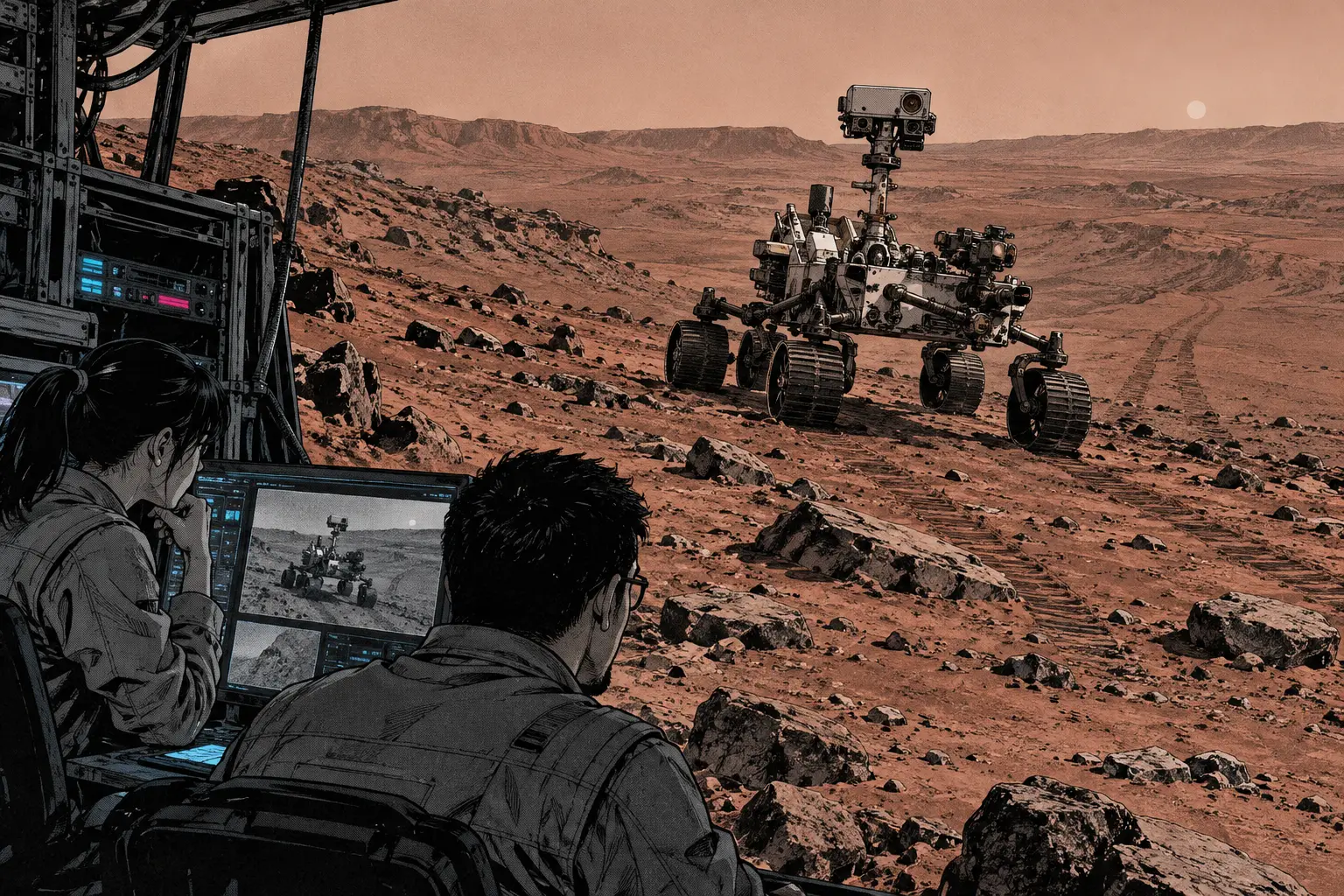
Perseverance has driven 45.22 kilometers across Mars, farther than any rover has traveled on the planet. A 299.6-foot drive on October 11, 2026, pushed its total to 28.10 miles, passing Opportunity’s previous record of 45.16 kilometers, according to IEEE Spectrum.
Opportunity accumulated that distance over its 15-year life after landing in January 2004 for what was planned as a three-month mission. Its journey ended after a planet-wide dust storm stopped it, with the mission ending in February 2019. Perseverance, which landed on February 18, 2021, overtook it in about five years despite Curiosity having operated on Mars since 2012.
The difference is not simply speed. Perseverance drives itself about 90 percent of the time, using an enhanced AutoNav system and a second processor with a field-programmable gate array to accelerate image processing. The rover can move autonomously at up to 120 meters an hour. By comparison, Opportunity and Curiosity used autonomous driving about 5 percent of the time, according to Mark Maimone, Perseverance robotic operations deputy team chief at NASA’s Jet Propulsion Laboratory.
Humans still decide where the rover should go. Science teams select destinations, strategic planners trace a broad route from orbital imagery, and tactical teams combine that route with each day’s science work. Perseverance’s onboard autonomy then measures nearby terrain and steers around hazards that may be difficult to see in orbital images, which can sometimes have a resolution of 25 centimeters.
That division of labor matters because the rover’s autonomy reads terrain shape but not terrain type. Human planners designate dangerous areas such as sand patterned with crossing crests, where the rover tends to sink. A large rock may also span only one or two pixels in an orbital image, making it difficult to notice and leaving the rover’s autonomy to avoid it.
The system has encountered limits. The team stopped using autonomy for about two months when Perseverance entered more complex terrain, while engineers adjusted parameters and wrote new software. The rover spent its first three years mostly driving on slopes below 14 degrees, but leaving Jezero Crater exposed it to steeper ground and denser rocks. Experience there allowed engineers to retune the system for slopes of up to 24 degrees; on steep slopes, sideways slipping is a concern.
As the rover drives, its estimate of its own position becomes less certain. As that uncertainty grows, software must expand the safety margins around human-designated keep-out zones until a route may become impossible to plan. A newer capability called Mars Global Localization can reduce that uncertainty and could, in theory, let Perseverance keep driving as long as it has sufficient resources and can navigate safely using its maps and keep-out zones.
The record therefore marks progress in sustained autonomous mobility, not a fully independent Mars mission. Long periods without human assistance would also require the rover to execute science operations autonomously. Personnel at JPL are examining onboard image processing to better understand the surroundings and determine where instruments should focus. Spectrum cited ruggedized wheels as another reason Perseverance overtook Opportunity, but identified autonomy as the biggest contributor.