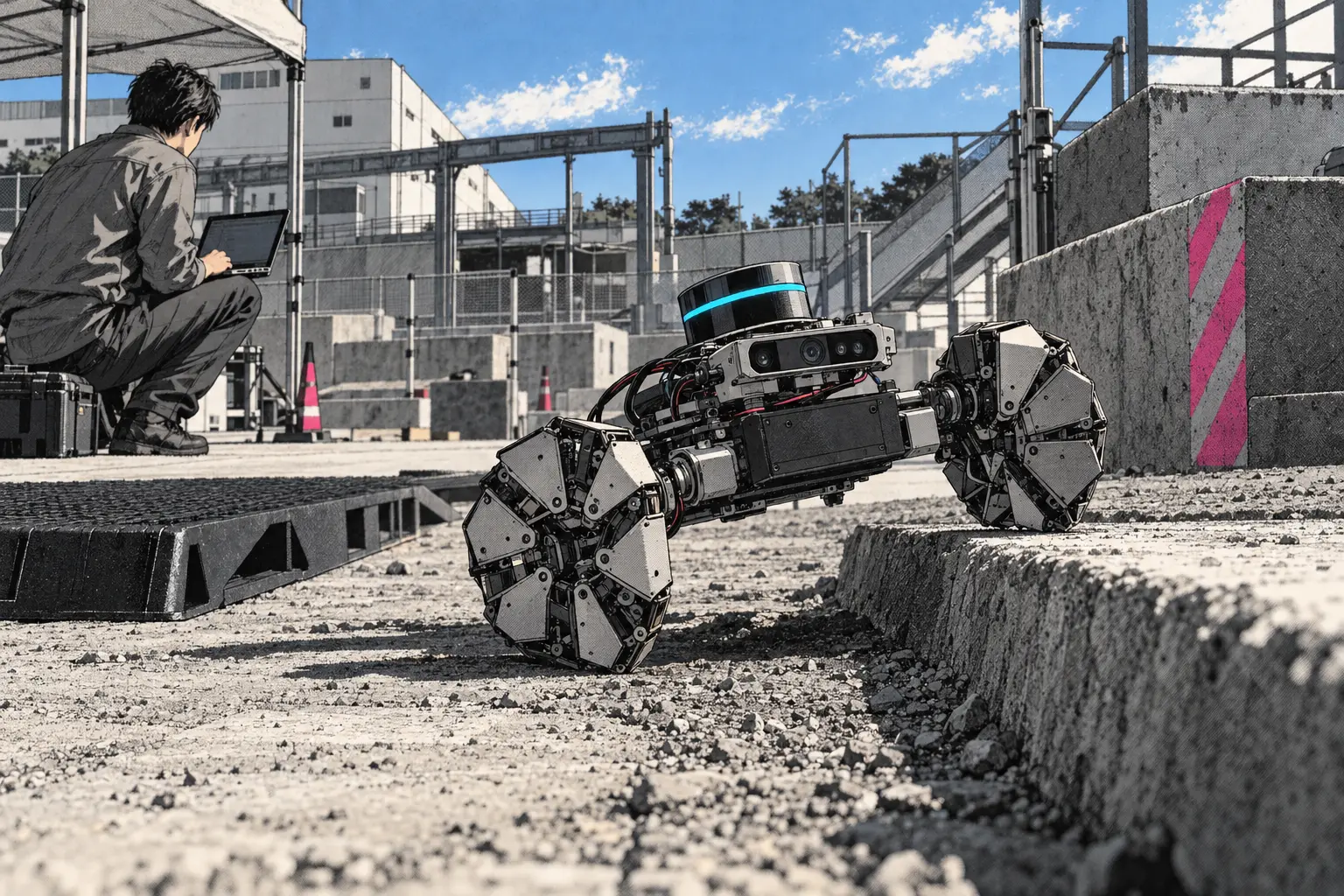
A compact robot reduced the mean share of invalid depth pixels in a sunlit outdoor test from 48% to 18% by fusing a wheel-pitched 2D LiDAR with an RGB-D depth stream, according to an arXiv preprint. The same system cut invalid depth indoors from 21% to 11%, targeting conditions where bright light or a lack of visual texture can leave a depth camera with holes in its view.
The mechanical trick is to make the wheels serve two jobs. They shift between origami-inspired, terrain-adaptive configurations for locomotion, but that movement also changes the pitch of the chassis. Because the 2D LiDAR moves with the body, the scanner sweeps through intermediate elevations as the wheels reconfigure. Holding the wheels in a chosen position fixes the sensor at a selected viewing angle.
That gives the robot an adjustable LiDAR viewpoint without a dedicated scanner-tilt actuator. The design instead reuses wheel actuation already installed on the prototype, which weighs less than 2 kilograms and costs less than US$300. The preprint describes the LiDAR angle as continuously adjustable, although its summary does not provide the angular range, positioning precision or time required to move between configurations.
An inertial measurement unit tracks the chassis attitude as the wheel geometry changes. A fusion node then projects the LiDAR returns into the depth stream from the RGB-D sensor, and the combined data are passed to RTAB-Map. In practical terms, the laser supplies measurements where the depth camera may fail, while the IMU helps account for the fact that the scanner is being pitched by the robot’s moving body rather than held level.
The researchers tested the sensor configurations in two deliberately difficult settings: a textureless indoor corridor and a sunlit outdoor area. Each configuration was run three times in each setting. The reported figures are full-frame averages, so they measure how much of each depth image remained invalid; the summary does not report run-to-run variation, mapping accuracy or whether particular obstacles became easier to detect.
The work remains a limited prototype trial rather than proof of rugged terrain performance. The supplied report gives no locomotion speed, battery life, duty cycle, wheel materials, obstacle dimensions or mechanical durability results. It also does not quantify whether changing the sensing angle disrupts traction or steering. Still, the experiment demonstrates a concrete piece of mechanical economy: one reconfigurable wheel system can alter both how a small robot moves and where its range sensor looks.