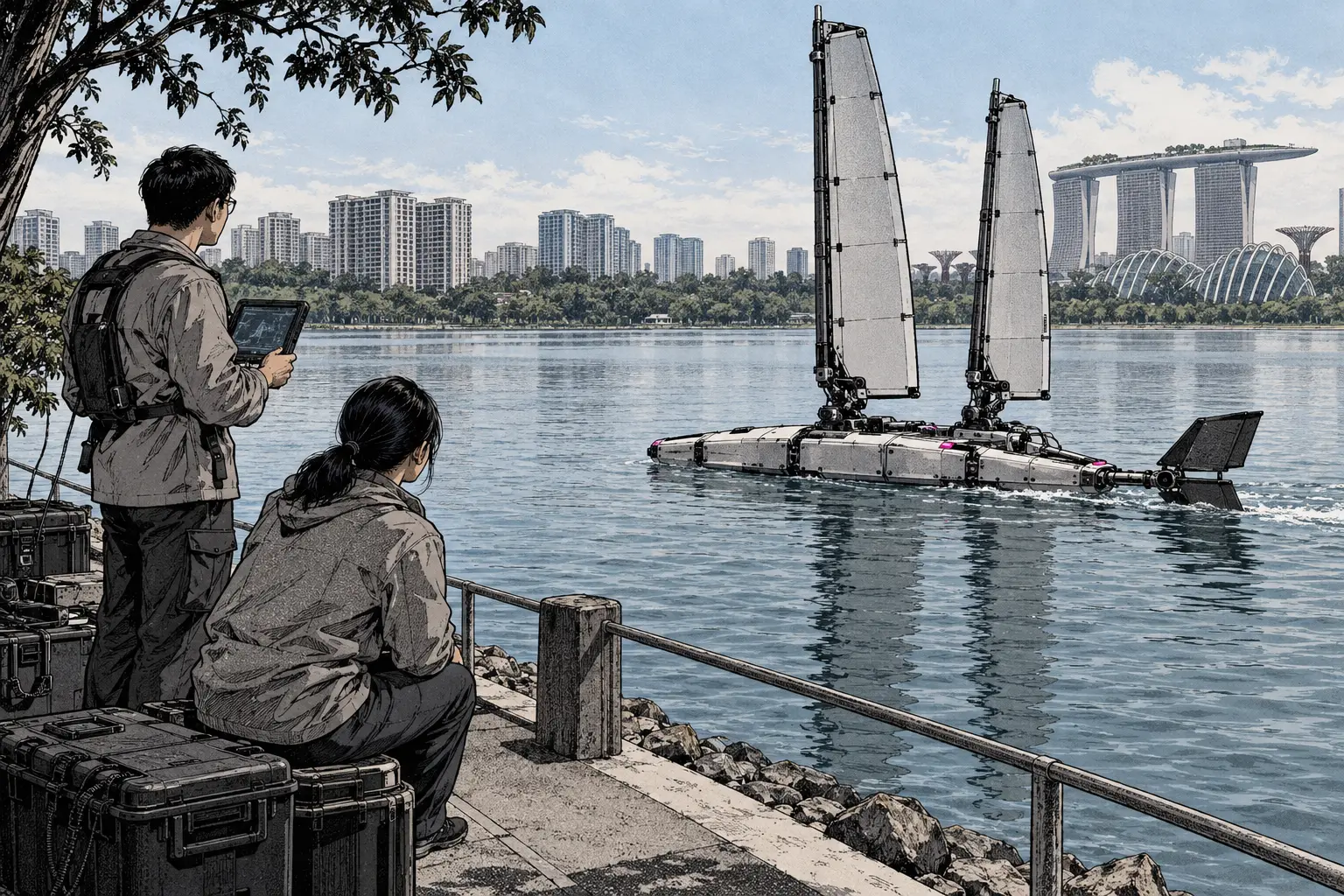
A robot released 150 metres above water used two rigid wings to autorotate like a falling maple seed, landed, righted itself and then reused those wings as sails. The test demonstrated an unusual air-to-water transition intended to place long-duration monitoring platforms in remote waters without a separate parachute or landing mechanism.
Researchers at the Singapore University of Technology and Design call the platform ALBATROSS, short for Airborne Lander with Buoyant AuToROtating Sailing Sensor. The concept is designed to be carried rapidly to a monitoring area by aircraft, dropped over the water and left to navigate between set waypoints using the wind.
During descent, the wings rotate passively, slowing and stabilising the machine. New Atlas reported that the prototype reached the water with low impact after its 150-metre drop. The researchers estimate that a comparable platform without the autorotation system would experience about 18.5 times more impact energy, although the report does not provide measured impact forces or descent speed.
Once afloat, the robot relies on its weight distribution to turn itself upright. Its two aerial surfaces then act as wingsails, while a fish-tail-inspired rudder steers the craft. The platform navigates autonomously between waypoints using three actuators and three navigation sensors.
A larger prototype reached a peak sailing speed of about 1 km/h during reservoir trials in Singapore. It operated for about three hours while gathering data on humidity, heat levels and wind direction with onboard sensors. The researchers say future deployments could remain at sea for weeks, but that endurance has not yet been demonstrated.
The machine addresses a deployment trade-off. Surface vessels can remain in an area but may take considerable time to reach remote sites, while aircraft arrive relatively quickly but cannot stay there as long. ALBATROSS separates those phases: an aircraft handles transport, passive autorotation handles descent, and wind powers movement on the water.
The prototype has operated only in controlled, sheltered environments and has not been tested in open-sea conditions. The report does not disclose its dimensions, payload capacity, energy storage, communications range or performance in weak or shifting winds. The team’s next step is to make the platform more rugged and durable for open-sea operation, with possible future additions including underwater sensors and sonar.