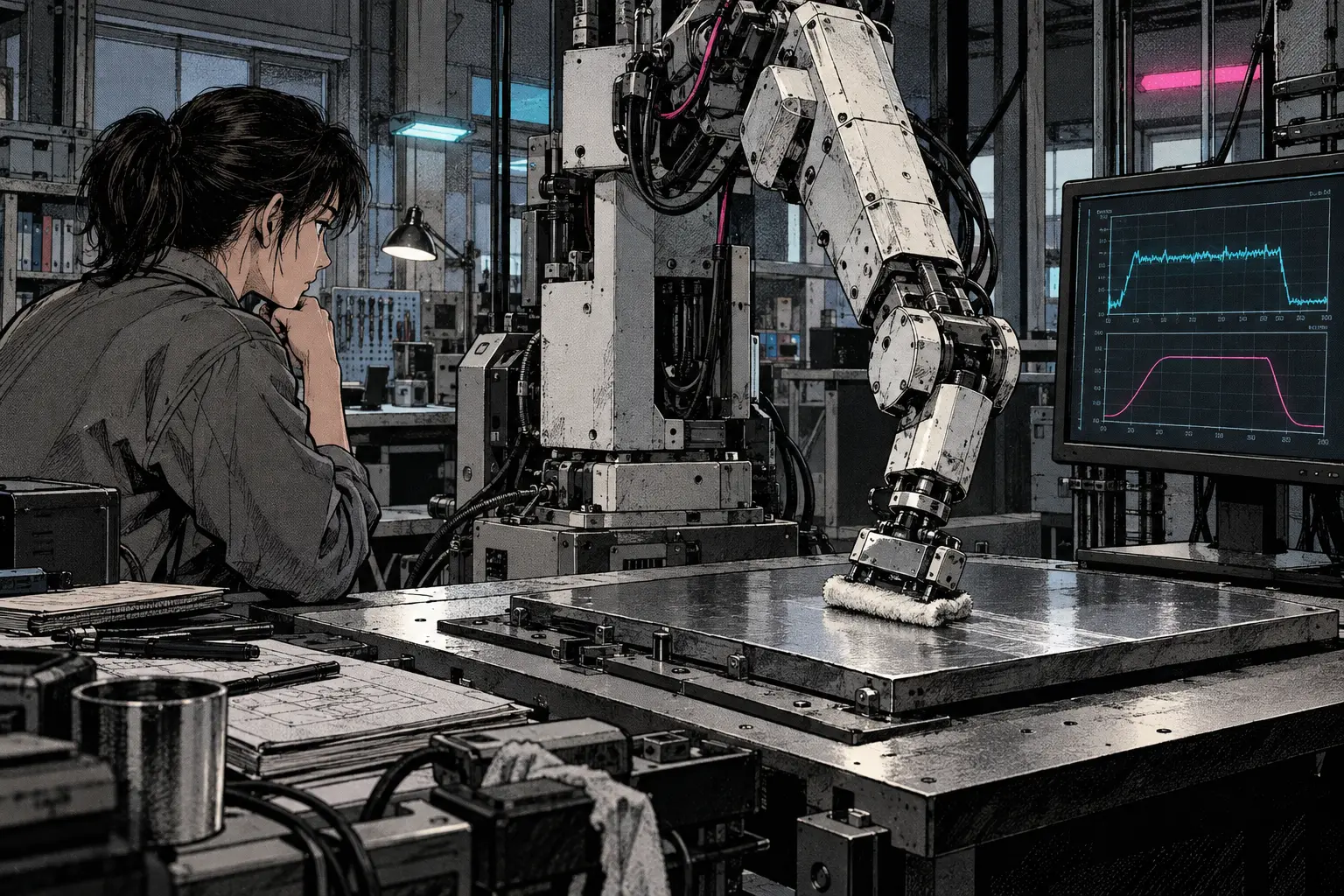
A robot transferred wiping, rotation and insertion behaviors from one demonstration to objects excluded from training, achieving a 78.7% overall success rate.
The result, reported in an arXiv cs.RO preprint, addresses a limitation of robot imitation: behaviors can involve similar motions while requiring different contact intensities or patterns. Visual and kinematic information alone may therefore be insufficient to specify the intended physical interaction.
The researchers’ Contact Trajectory Prompting framework, or CTP, encodes motion and contact information from a demonstration as an ordered contact trajectory. The prompt captures how the interaction evolves over time. During execution, the policy uses online sensory feedback to retrieve interaction-relevant information from the prompt and generate actions in a closed loop.
The framework is designed to transfer a behavior without changing the policy’s parameters at test time. According to the preprint, changing only the reference demonstration let CTP follow different contact intensities or directions. It followed an intermediate wiping-force level and rotated caps clockwise or counterclockwise according to the demonstration.
Across the real-world wiping, rotation and insertion experiments, CTP’s 78.7% overall success rate was 13 percentage points higher than that of the strongest evaluated baseline. The experiments used objects excluded from training, and the policy conditioned its actions on the contact behavior encoded in the prompt.
The supplied abstract does not state the number of trials, robot model, sensing hardware, execution speed, absolute force ranges or results for each task type. It also does not describe the unsuccessful runs. The reported evidence is therefore limited to the evaluated wiping, rotation and insertion tasks, in which one demonstration specified both motion and contact behavior without test-time parameter updates.