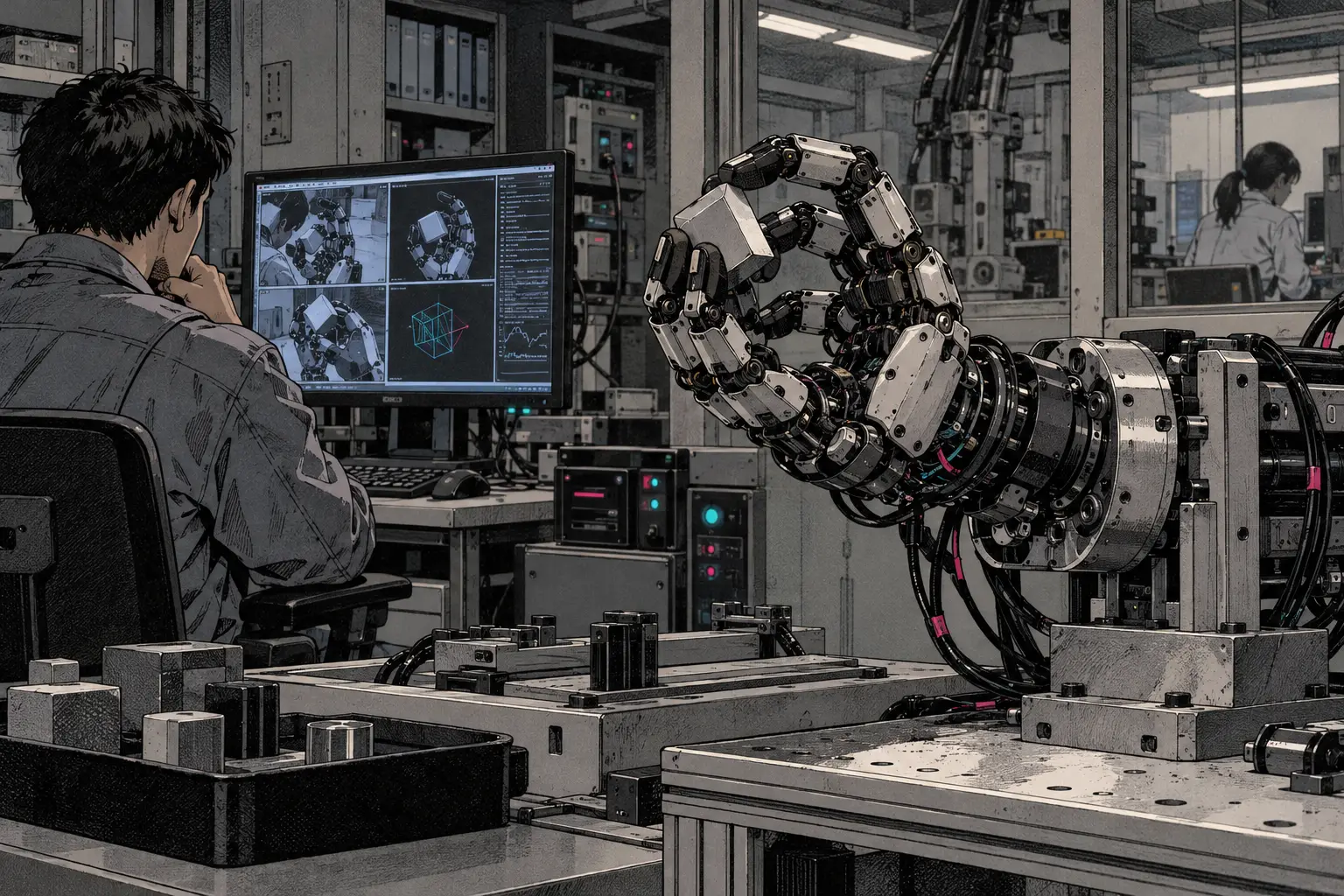
A robot trained on minutes of human play went on to collect hours of contact-rich manipulation data autonomously. The approach uses a brief period of supervised play to generate a larger interaction dataset.
The system, called Dexterity from Supervised Play, or DSP, is described in an arXiv preprint. It was evaluated on underactuated pushing and any-to-any in-hand pose reorientation with a multifingered hand, in simulation and the real world.
DSP begins with behavior cloning, through which the robot learns a play policy from minutes of human play. The robot then runs that policy autonomously for hours, producing interaction data used to train a world model.
At inference time, the play policy supplies candidate action sequences to model-predictive control. The controller evaluates those proposed sequences under the learned world model. The approach does not require demonstrations for specific tasks, according to the preprint.
The researchers also distilled a closed-loop, goal-conditioned policy through self-play inside the learned world model. That step is intended to accelerate inference. The preprint says the overall method requires neither task-specific demonstrations nor simulation-to-real transfer.
In the real-world experiment, DSP outperformed hindsight behavior cloning by 69.6% in success rate and achieved success described as comparable to reinforcement learning while using 490 times less interaction data, according to the report. The supplied results do not give the absolute success rates, clarify whether the 69.6% figure is relative or measured in percentage points, or disclose the exact duration of the physical dataset. The reported evaluation covers two manipulation settings, so performance on unfamiliar objects, longer tasks and other contact failures is not established.