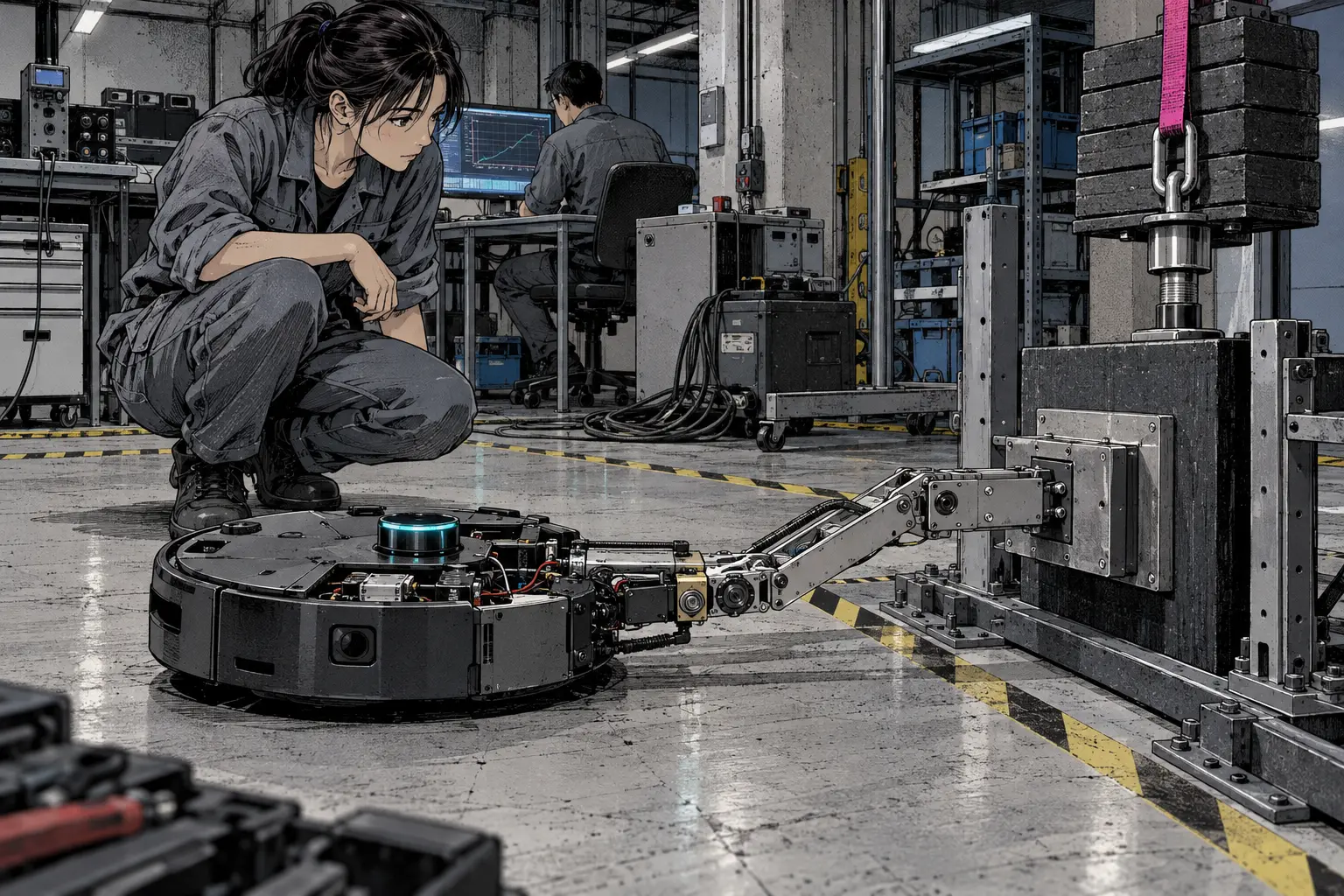
A deployable plate fitted to a robot vacuum held a 50-newton load with its motor de-energized, according to an arXiv robotics preprint published Wednesday. The mechanism is designed to let the vacuum deploy a load-bearing surface for pushing household objects without continuous motor torque.
The two-stage linkage locks through its geometry. At full deployment, an internal chain of three links approaches a collinear, near-singular configuration. In that posture, force on the plate produces a small residual back-driving torque because the mechanism’s input-output transmission ratio approaches zero. This reduces the tendency of the load to fold the linkage back into the vacuum.
The lock is not entirely frictionless or purely geometric. The small torque that remains is resisted by friction in the drive train and a lightweight magnetic detent. One actuator both unfolds the linkage and moves it into the locked position. A passive trigger mounted on the chassis releases the lock for retraction, while a second actuator adjusts the deployment height.
The researchers integrated the system into a commercial robot vacuum and subjected it to a 100-cycle repeatability test. They also conducted the 50-newton quasi-static load test with the motor de-energized. The supplied report does not describe tests involving impacts or off-axis forces, or durability testing beyond the 100-cycle test.
The reported tidying trials used the deployed plate for pushing. The team ran 140 trials involving seven household objects and compared the modified vacuum with a commercial arm-equipped vacuum robot under what the paper describes as a documented protocol. The supplied report does not give the individual object types, success rates or comparative results, so it does not show how often either system completed the tasks.
The researchers describe the design as an intermediate point between passive compliance and articulated manipulation. It uses one actuator for deployment and locking and another to adjust deployment height, while the self-locking posture avoids the need for continuous motor torque at full deployment. The supplied report does not provide deployment speed, linkage dimensions, added mass, energy savings or effects on battery life.