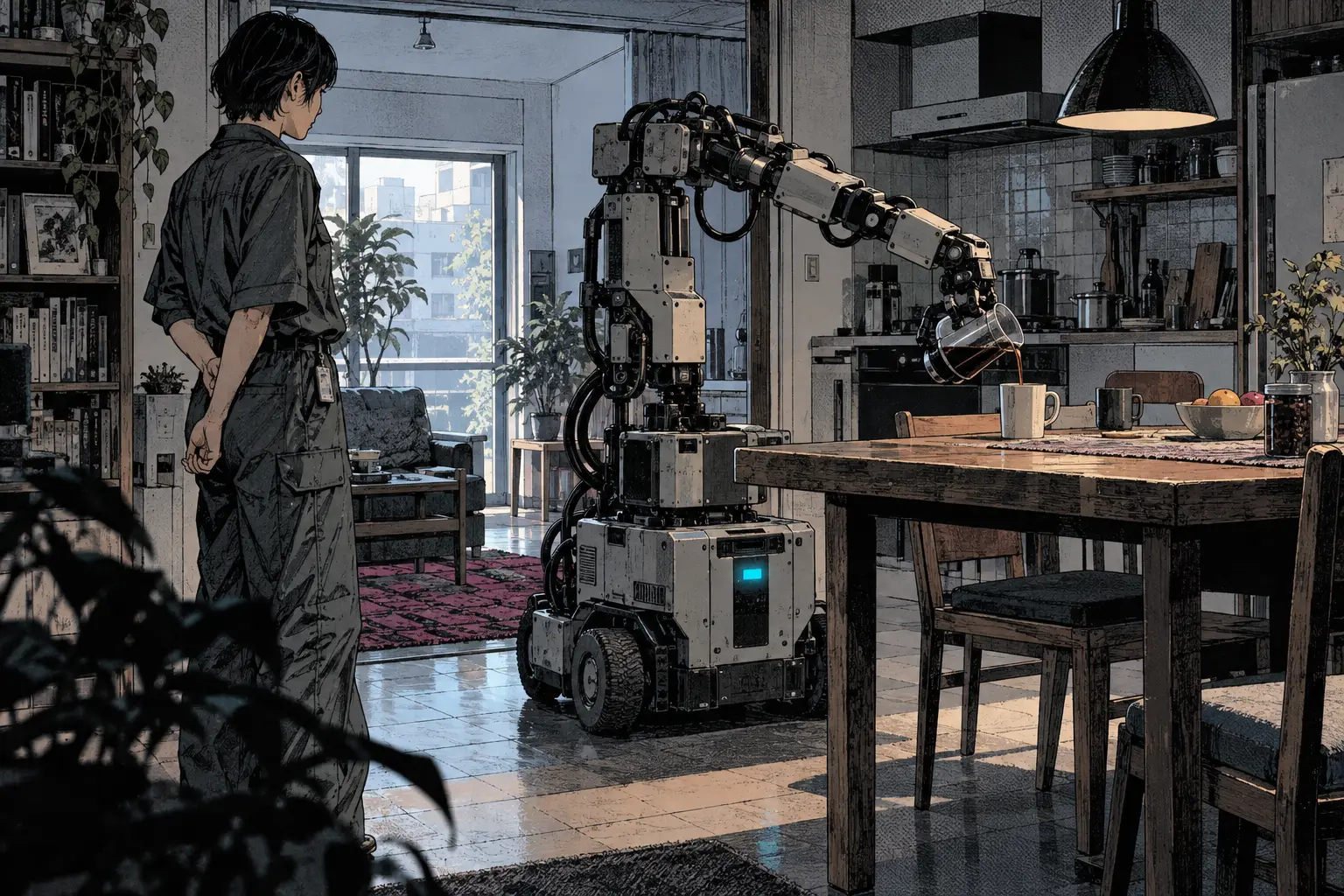
A mobile-manipulation system trained entirely in simulation reportedly transferred to physical restocking, pouring and cleaning tasks without real-world fine-tuning. The result, described in an arXiv preprint, addresses the cost and complexity of collecting real-world data for vision-language-action robotics.
The system, called SimVLA, is an end-to-end vision-language-action framework for mobile manipulation. According to the preprint, it was trained entirely on synthetic simulation data without teleoperation. The authors present simulation as a scalable alternative to collecting real-world robot data.
Its first training source, SimAction, contains robot actions spanning 35 mobile-manipulation tasks. The researchers generated the dataset by composing atomic skills rather than collecting teleoperated physical demonstrations. This kept its data generation within simulation.
A second dataset, SimVQA, used privileged simulator state to provide spatial, geometric and subtask-level visual-language supervision. SimVLA was then post-trained on a mixture of SimAction and SimDeploy, which contains policy rollouts collected across diverse simulated environments.
The researchers evaluated the resulting policy on tasks including restocking, pouring and cleaning, with real-world mobile-manipulation tests that included home environments. They report that SimVLA transferred zero-shot, without adaptation using real-world examples from the target setting. They also say it outperformed policies trained on 50 in-domain real-world demonstrations.
That comparison is potentially significant, but the supplied report leaves critical engineering details unstated. It gives no task-by-task success rates, trial counts, completion times or failure modes. It also does not identify the robot hardware, sensors, arm reach, payload, control frequency or navigation speed. Without those details, the report does not establish how reliably the system completed each task, what objects it handled or how much variation the physical tests contained.
The supplied evidence comes from an arXiv preprint, and the report provides no independent replication. The authors say the results suggest that simulation can support scalable sim-to-real mobile manipulation and that complementary forms of supervision help make use of simulated training. Additional hardware tests and disclosed success rates would be needed to assess how broadly the reported performance generalizes.