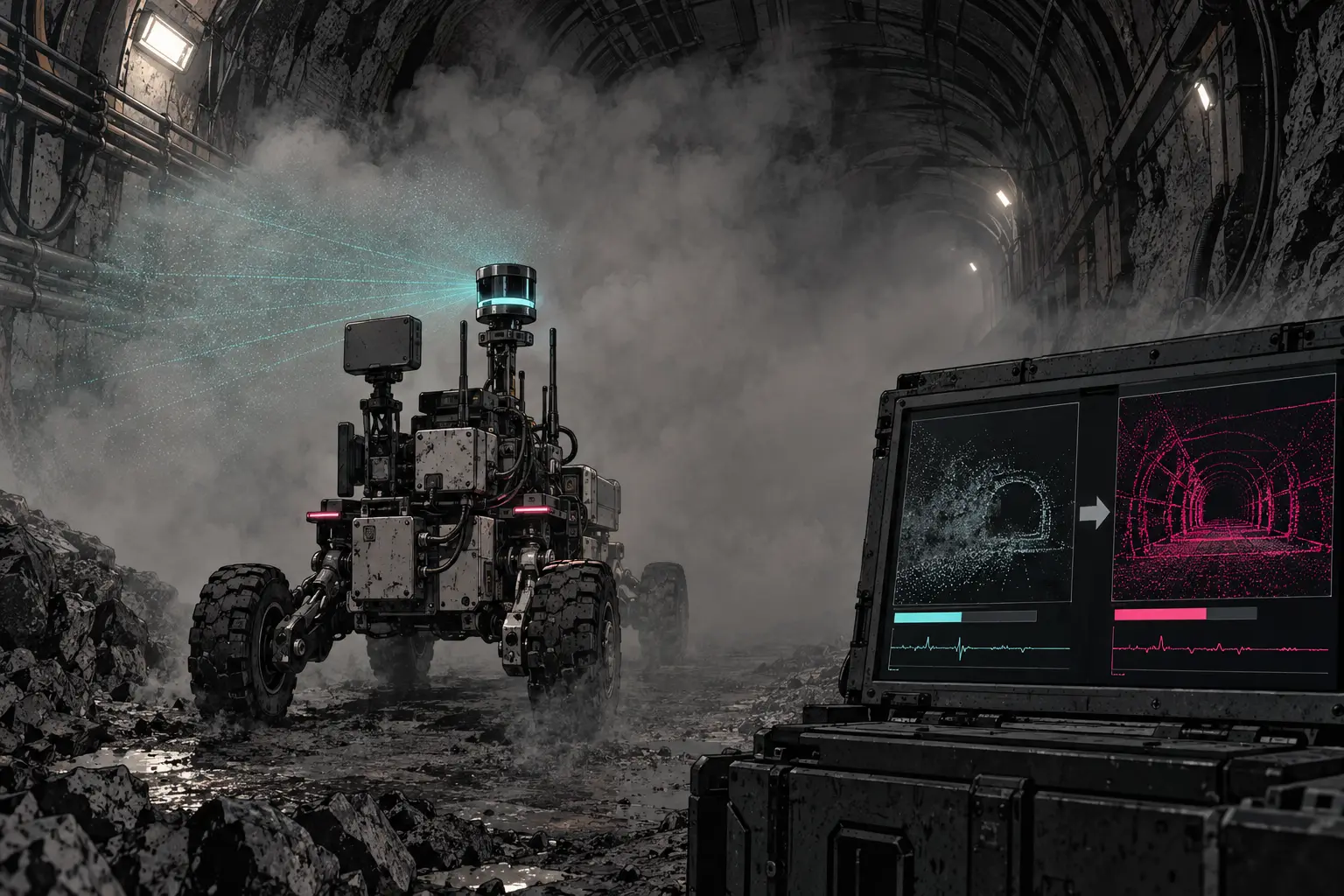
A ground robot continued producing localization output in a GNSS-denied tunnel after dense smoke severely degraded its LiDAR, with a new system transferring localization authority to radar-inertial odometry.
The localization framework is designed for subterranean conditions where airborne smoke, dust and other obscurants can make LiDAR-inertial odometry unreliable. Radar remains comparatively robust in those conditions, according to an arXiv cs.RO preprint describing the work. The system adaptively selects between LiDAR- and radar-based odometry according to its estimate of LiDAR reliability.
Its central component is an LSTM autoencoder trained exclusively on data from nominal operation. It models how sensor-quality indicators evolve over sliding time windows and flags behavior that departs from the learned baseline. Because this is a one-class approach, the model does not require labelled degradation data. The report describes detection of abnormal sensor behavior rather than classification of the airborne obscurant causing it.
The researchers evaluated several families of degradation-sensitive cues. These covered the spatial distribution of LiDAR measurements, cross-modal information, geometric and motion information, return intensity and measurement recency. The resulting estimate represents LiDAR reliability. When LiDAR remains reliable, the system uses LiDAR-inertial odometry, or LIO. When degradation is detected, localization authority moves to radar-inertial odometry, or RIO.
Testing used real-world ground-robot data collected in GNSS-denied subterranean tunnels. The data covered both nominal conditions and dense smoke. The preprint reports that the framework detected degradation, switched between the two odometry systems and maintained localization output during severe LiDAR degradation.
Those results do not establish complete autonomous navigation through smoke. The supplied report provides no localization-error figures, switching latency, travel speed, tunnel distance or operating duration. It also does not report whether the robot avoided obstacles, completed a route or recovered its LiDAR estimate after leaving the obscurant. The supplied information therefore does not quantify accuracy during the radar handoff.
A feature-family ablation study found that a reduced feature representation improved degradation-aware localization performance in the evaluated dense-smoke scenarios. The authors say this highlights the importance of feature parsimony in one-class sensor-degradation detection. The supplied material does not report tests across other tunnel layouts, obscurant types or robot platforms.
The work is an arXiv preprint, and the researchers say the code will be released as open source. Based on the supplied report, the demonstrated result is degradation detection, adaptive transfer from LIO to RIO and continued localization output under severe LiDAR degradation.