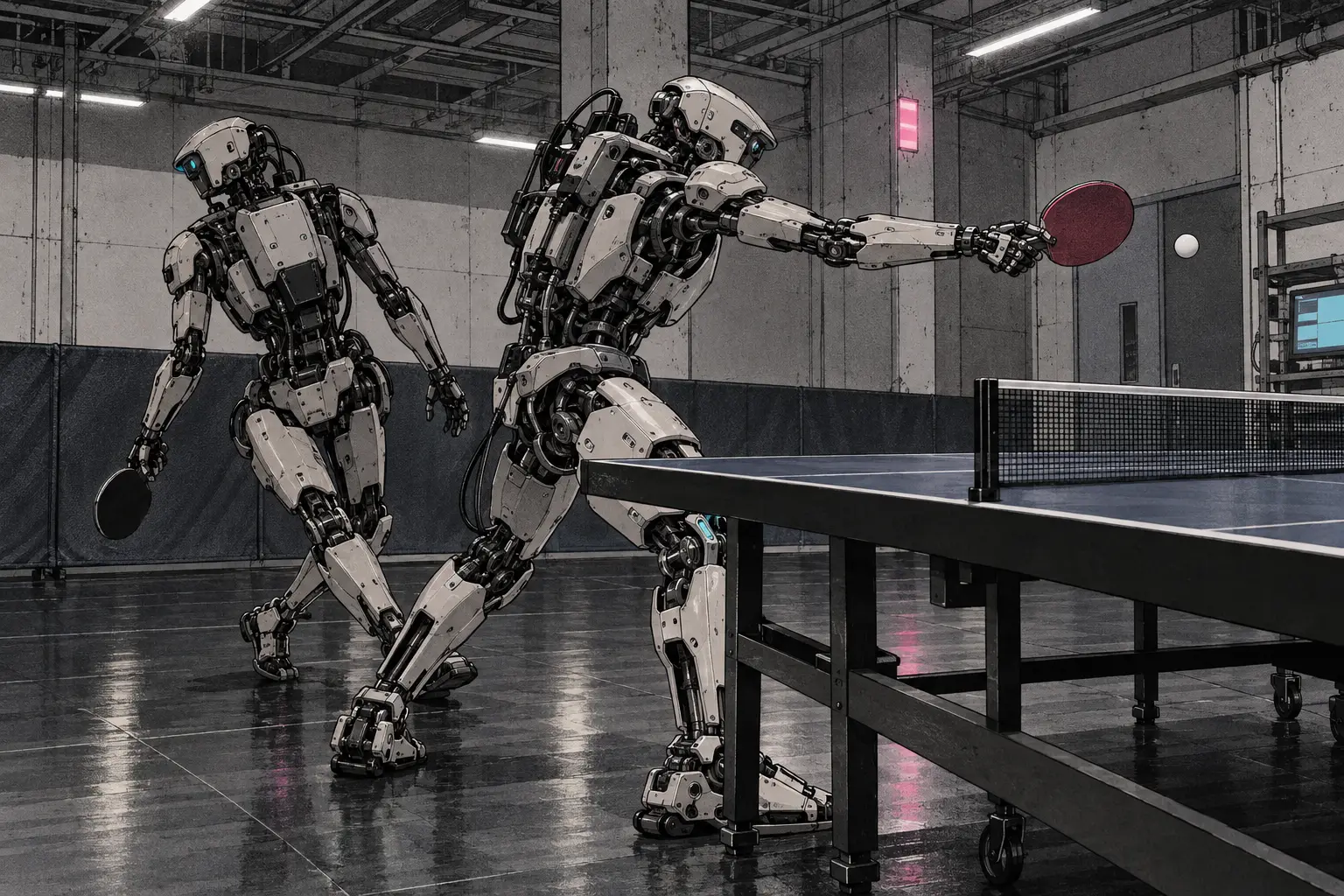
Two humanoid robots sustained more than 10 consecutive table-tennis strikes in strict alternation while repositioning inside the same confined workspace. The real-world demonstration, reported in a PingpongDuo preprint posted on arXiv, addressed the collision risks that arise as the robots alternate between striking and moving clear.
That makes the task different from a singles rally. The teammates must strike in strict alternation while sharing a confined workspace. Rapid repositioning can compromise striking accuracy, while uncoordinated movements introduce collision risks. The system therefore has to combine clearance and repositioning with racket control.
PingpongDuo divides those demands between a team-level planner and individual movement controllers. The planner jointly selects positioning targets for both robots, then uses learned risk estimates to filter risky proposals. In doing so, the system preferentially preserves the current striker’s target.
Each humanoid uses separate footwork and striking skills. Those controllers were guided by human motion references, including footwork collected from human doubles play, according to the preprint. The researchers also trained the skills from states produced by one another to support rapid transitions between movement and striking.
A racket-arm residual further refines strikes after the robot has moved. It uses return feedback from a simulator calibrated with measurements of real ball flight and contact. In simulation, the system improved ball-return success by 13.2% over what the researchers describe as a state-of-the-art baseline. It also achieved positioning errors of approximately 2 centimetres during clearance.
In real-world experiments, one robot completed a 2.15-metre clearance-and-recovery cycle in 2.4 seconds and reached a peak speed of 2.23 metres per second. Two robots also sustained the reported sequence of more than 10 consecutive strikes in strict alternation.
The supplied report does not disclose the humanoids’ model, dimensions, degrees of freedom, ball speed, battery endurance or exact longest rally. It also gives no aggregate real-world return rate, collision count or comparison against the baseline on physical hardware. Those omissions limit comparisons with the simulation results and leave longer-term real-world reliability unreported.