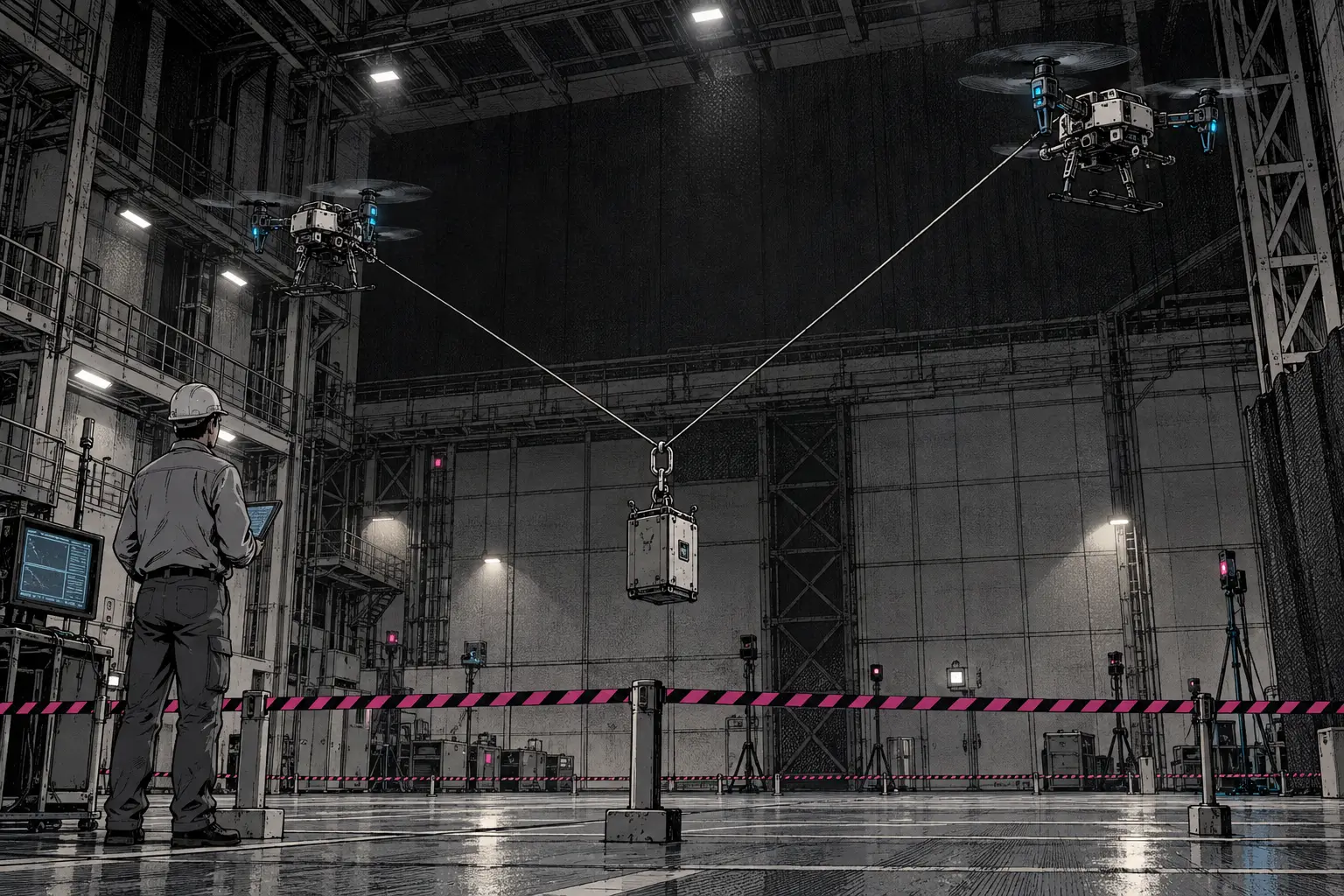
The paper presents two quadrotors transporting a hook-suspended payload on one continuous cable that can slide through the load’s attachment instead of remaining fixed. The experimental system, described in an arXiv robotics preprint, makes the sliding attachment part of the aerial transport problem.
The inextensible cable connects the two aircraft and passes through a hook mounted on the payload. As the cable slides through that hook, its distribution between the two segments can change while the total cable length remains constrained. The paper describes the hook as frictionless.
That changing split between the two cable segments introduces what the researchers call a cable-distribution variable. The paper says it couples the quadrotors’ motion, cable geometry and payload dynamics. The load therefore is not modeled as following two independently controlled tethers.
To manage that coupling, the researchers generated feasible reference trajectories from a desired payload pose, the cable distribution and the overall system shape. Their framework satisfies the total cable-length constraint and an elliptical workspace. The quadrotors track the resulting trajectories while maintaining positive cable tension and respecting actuator limits.
According to the preprint, the payload pose is estimated from the system geometry, while a direct measurement of its position is used only to validate the desired trajectory. The geometry connecting the drones, cable and hook is therefore central to reference generation and pose estimation.
The supplied report says the approach was evaluated through experimental demonstrations, but it does not disclose the payload mass, cable length, flight speed, tracking error, tension range, battery endurance or number of trials. It also reports no tests involving wind, obstacles, hook friction, cable snagging or a failed aircraft. Without those details or experimental results, the supplied material does not support conclusions about performance under such conditions or at other scales.