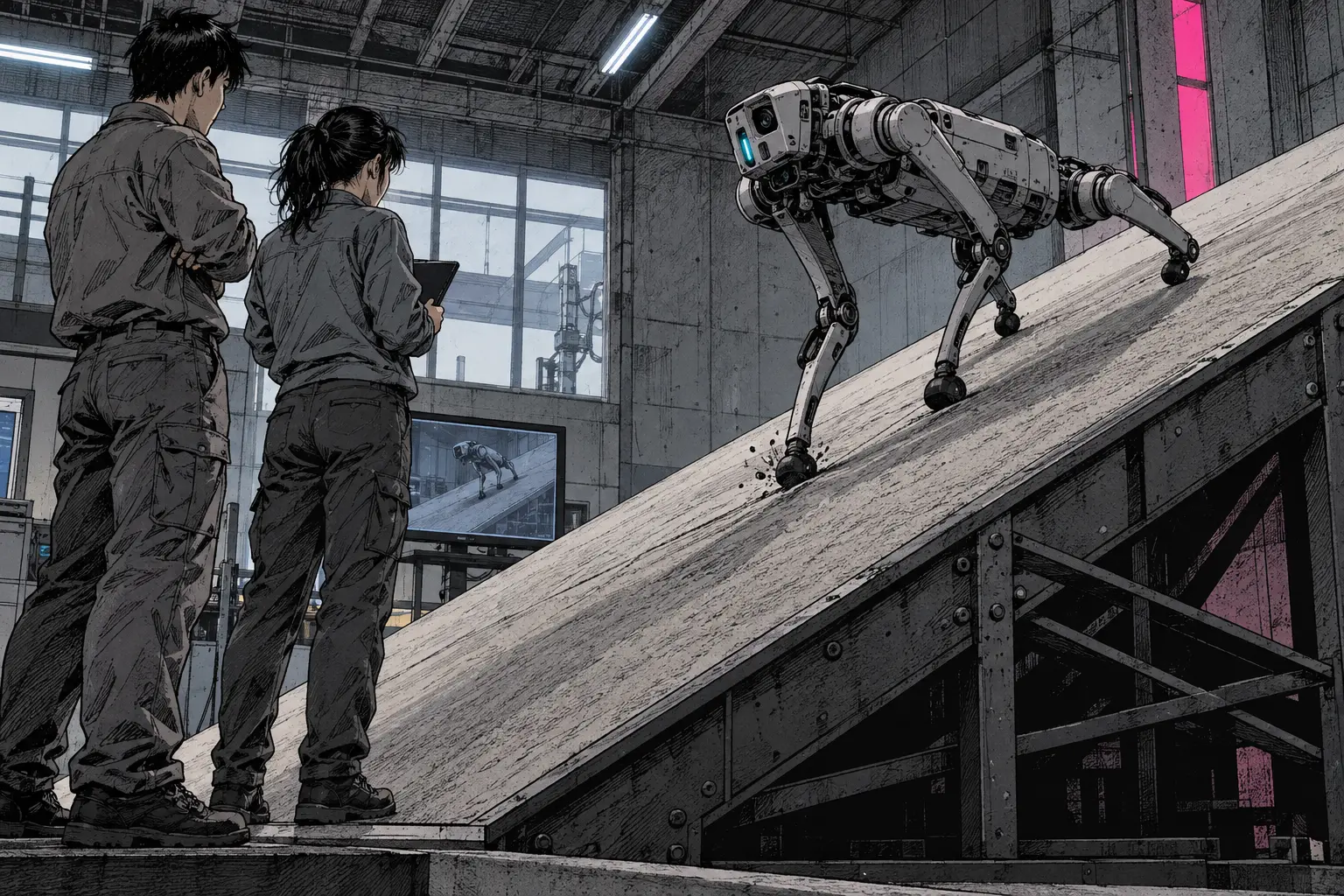
A Unitree Go2 quadruped experienced critical failures regularly on a roof test rig tilted to 25 degrees, according to an arXiv preprint investigating the feasibility of using walking robots for work on sloped roofs.
The researchers found that the commercial robot’s standard ball feet were inadequate for locomotion on the surface. Slippage increased quadratically with the roof’s incline angle. The supplied source material does not quantify the slip distance or define precisely what counted as a critical failure.
Get-up and lie-down sequences were possible only on small inclines, according to the paper. The result indicates that the robot’s standard transition sequences, as well as its walking performance, were limited by increasing roof slope.
The team built a dedicated roof-surface test rig to establish the Go2’s baseline performance. The paper presents the work as the first systematic assessment of quadruped locomotion in roof environments. The supplied material does not provide the rig’s dimensions, surface material, robot speed, trial count, tether arrangements, payload or battery figures.
The experiment was a locomotion assessment rather than a demonstration of construction work. The paper describes roofs as a possible setting for automating repetitive and strenuous tasks, but the supplied material reports no tests involving the Go2 carrying materials, operating tools or completing a roofing job.
The results show a mismatch between the Go2’s standard ball feet and locomotion on the tested sloped roof surface. The feet were deemed inadequate, slippage increased with incline, and critical failures occurred regularly at 25 degrees.
The authors say effective roof robots will require task-oriented foot designs, advanced contact mechanics and environment-specific control strategies. They identify reinforcement learning for roof-adapted gaits as one possible approach. The supplied material reports baseline Go2 tests, not evaluations of redesigned feet or roof-adapted gaits.