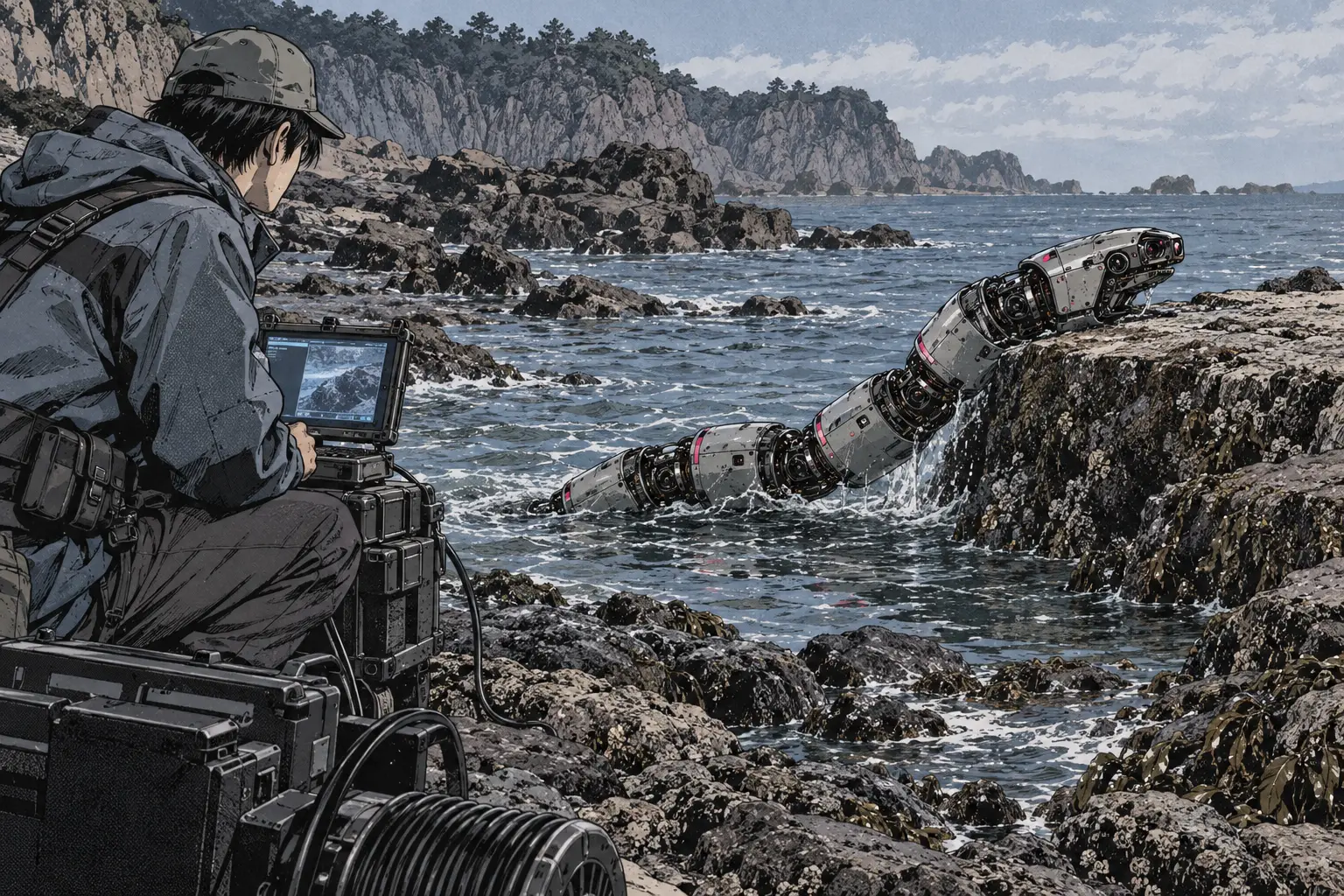
WorMa climbed steps up to 15 centimeters high using a sequence that pumped water back and forth through its body while it raised its head and pulled its tail forward. The maneuver addressed the challenge of moving across the rocks, slopes and water found along coastlines, according to New Atlas Robotics.
The worm-shaped machine is 50 centimeters long, weighs just over 1 kilogram and consists of five connected segments with four joints. Two latex balloons, positioned in its head and tail, hold a combined 300 grams of water—almost one-third of the robot’s total mass. A pump in the middle section transfers that water from one end to the other, shifting the machine’s center of mass.
That internal mass transfer changes how firmly each end presses against a surface. For an uphill climb, WorMa pumps water toward its head, increasing contact force and traction at the front. New Atlas reported that the robot climbed inclines of up to 19.5 degrees using this approach. The report did not give its climbing speed or describe how loose, wet or uneven the test slopes were.
The sequence becomes more involved at a step. WorMa first moves water forward to provide traction, then pumps it backward to make it easier to lift the head and push it toward the ledge. After its head and neck joint are anchored on the edge, the robot sends the water forward again so it can pull its tail forward. Repeating that cycle allowed it to clear steps as high as 15 centimeters.
The same mass-shifting mechanism also assists movement in water. Moving the water toward the tail helped the robot swim about 26% faster than it could otherwise, according to the report, although no absolute speed was provided. To leave the water, WorMa moved the water toward its head, increasing traction at the front so it could pull itself onto a sloped shore.
The system relies on a pump, two latex reservoirs and controlled weight transfer. The research team is working to make the pump faster. New Atlas did not report the robot’s battery endurance, water-transfer time, payload capacity or duty cycle.
WorMa is not yet autonomous. It has no sensors for identifying the terrain it faces, so its weight shifting is controlled externally. The researchers intend to add sensors and terrain recognition so the robot can distribute its weight on its own. The research was published in Advanced Robotics Research.